By: Allie Wassum with contributions from Boston Social Strategy team
The last decade was particularly vibrant for social media. Remember what 2010 was like? Facebook had just surpassed Myspace in unique users with 350 million users. Foursquare had just launched and in less than 3 years became irrelevant. Mobile was just starting to disrupt desktop usage for entertainment and social networking. Social media marketing was a wild west (some argue it still is), with just over 40% of US adults using it regularly. Fast forward to 2020 and that number has increased to over 70%. Social is now woven into the threads of culture and our culture has forever been changed.
1. The rise of influencers
In 2019 the term ‘influencer’ was finally added to the dictionary, marking its ubiquity outside of just the marketing world. Over the past decade, an influencer changed from being a household name like Jackie O to a handheld name like David Dobrik.
Digital influence began to grow as soon as camera technology became synonymous with mobile technology and social networking moved from being about just sharing pictures on your camera roll to sharing pictures of yourself.
Pair these technological advances with every social platform’s continued focus on who you follow versus what you’re interested in. It’s this emphasis that led to the exponential growth we’ve seen in influencer culture in the past decade. As each social platform has improved its functionality to help users explore and find new accounts to follow, the democratization of influence within these channels exploded, leading to micro-influencers and even the nano-influencers we might use for brand campaigns today.
Influencers have had an enormous impact on the social media landscape:
-
- The first, and probably most obvious, is the immeasurable pressure placed on “likes” as a form of status. Constantly comparing yourself to an influencer has been proven to promote negative self-worth and impossible standards, not unlike those constructed by popular magazines.
- Creators and influencers are often small business owners. Many openly speak about what it means to be an entrepreneur and want to share what they’ve learned. This encouragement has fostered one of the most entrepreneurially-focused generations we’ve ever seen. Nearly half of Gen Zers plan to own their own business and one of the most popular career aspirations for young Americans is to become an influencer.
- Influencers have also cultivated a sense of community in social media that may not have happened otherwise. Think about it: having access to celebrities lives and having the potential to actually interact with them keeps you coming back for more. It also makes the world feel smaller.
- The rise of influencers has enabled social media to become not just about conversation and entertainment, but also about shopping. Without influencers, it’s unlikely that the rise of commerce via apps like Instagram and Pinterest would have become so pronounced. When you see someone you follow endorsing a product in an environment where it’s encouraged to ask questions, you’re definitely more likely to buy right then and there.
- Finally, no change happens in social without influencers being privy to it. Think about Instagram testing the removal of Likes. Influencers expressed varied opinions which will ultimately impact how the platform rolls out this change.
2. Timeline to algorithm
Prior to 2009, platforms focused on organizing content in users’ feeds chronologically – ensuring the most recent content was seen first. But Facebook noticed something in the last decade that would have widespread implications for its revenue model: people weren’t spending the same time on the platform. Since Facebook needed users to spend more time in platform, it had to make sure the content user’s see when they get to Facebook is relevant, not just recent. Thus, EdgeRank rolled out in 2009 prioritizing affinity, weight and decay.
Over the rest of the decade, EdgeRank morphed into a complex algorithm that constantly optimized and thereby constantly morphed how users and brands used the platform. Prominent changes included: the deprioritization of branded content, focusing on friends/family over news, prioritizing video content and, more recently, making Groups more prominent.
 Facebook’s algorithmic shift ultimately rolled out from platform to platform as they all realized the revenue power associated with it. With this, the importance of organic social dwindled and it became a “pay to play” environment for brands. Steadily, spend in paid social increased from $1.2B in 2008 to Facebook alone bringing home over $43B in 2019 global ad revenue. That increase has changed the entire user experience of social. It means ads are just a part of our feeds and the amount of media messages we consume in aggregate has increased exponentially.
The introduction of this algorithm has impacted not just social, but also the world. Many argue that we have algorithms to blame for the online echo chambers that contributed to off base 2016 election predictions and, ultimately, to an even further fragmented society.
For all of the negatives attributed to algorithms there are some positives too. Spotify knows what I want to listen to. Netflix knows what I want to watch. Instagram knows what I want to buy. Pinterest knows what I’m planning to do. The barriers to finding the unique things you love are much lower, though the tradeoffs have pervasive implications for data privacy. But let’s keep that can of worms closed for now.
3. The Selfie
 Oh, the Selfie. The selfie. THE SELFIE. Selfies have transformed the face of social media from feeds full of photos folks took, to feeds full of photos of one another. But the act of capturing a self-portrait is not something new to this decade. Throughout history, everyone from artists to astronauts have found creative ways to leave their mark. Even as camera technology steadily improved over the years, the means of taking photos of ourselves was still pretty difficult. It wasn’t until Sony introduced the front-facing camera in 2003 to enhance business meetings that self-portraits finally became easier to capture. Yet, few people actually had this device. Enter the iPhone 4. It was in this model that Steve Jobs unveiled a front-facing camera meant to support its new Facetime service. We’d use it for Facetime, but we’d also use this functionality to forever change the nature of what we share.
The convergence of social networks (where you strive to show your best self) with technology (where you can very easily capture photos of yourself when you’re at your best) provided an addictive outlet for performance and vulnerability like nothing had before. The selfie allowed users to share moments of confidence, of pride, and receive real-time feedback. Paired with the potential for virality inherent in algorithms, the selfie would drive us to seek approval, build confidence and maybe, just maybe, become famous.
Apps like Snapchat and Instagram now thrive on the selfie. It’s this variable ratio schedule that keeps users on their platforms, driving up time spent in platform and, of course, ad revenue.
4. Stories & Ephemerality
Without the selfie, “Stories” never would have taken off. But because selfies had already skyrocketed in popularity and phones were more vertically-oriented, peopled swooned when Snapchat launched the format back in 2013. Reggie Brown, credited with the inception of the app, hit on something no one knew they needed – a way to share photos that would eventually disappear. At the time every piece of content felt so permanent and as such, every post held an associated reputational risk. But ephemerality reduced that risk, allowing people to be less curated and way more spontaneous.
Ephemerality was the key that would unlock an untapped world of interactivity and creativity. It let our guards down and once this happened users started to share the silly, uncut tales of their everyday lives. Whether via video, a succession of photos or just in one frame, Stories empowered storytelling. Prior to Snap stories, our creativity was limited by time and functionality. Sure, we had cameras in our hands, but we didn’t have the means to quickly make our perspectives understandable. A selfie of me in class is completely different than a selfie of me puking rainbows, with the caption “acing the test like…”.
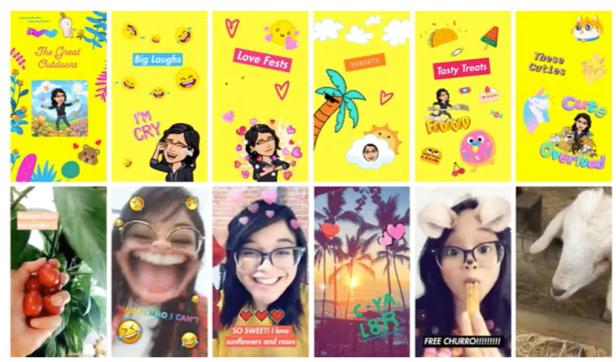 Stories also took off because of the generation they catered to – Gen Z (born between 1995-2015). With seemingly unlimited access to almost any form of media, they are the most creative of all generations. Augmented reality, polls, filters, geo-filters, GIFs, etc., revealed this creativity and provided a more genuine outlet for Gen Z to share its vision with the world.
Today Stories have harnessed this creativity in a way that’s beneficial for our mental wellness and relationships. The pressure for the picture-perfect life can erode our self-worth, but stories finally provided an escape and a way to interact more comfortably and more regularly.
5. Private messaging
What we can see publicly in our social feeds is only the tip of the iceberg. The majority of sharing and communication in social actually happens under the surface via private messaging. In fact, 63% of people report messaging apps to be their favorite way to send content or recommendations to those in their circle. Despite its popularity as a social medium today, the first era of messaging focused on simple desktop clients (Aim Messenger anyone?). It wasn’t until iOS launched in 2007 that mobile messaging apps inundated the space.
But what led to the creation of 5 billion global private messaging accounts today? The tiniest little thing – the three-dot typing indicator. In text this little notice let us know someone was around and that the conversation could continue. This extended the length of private text conversations and led to a greater feeling of connectivity.
We needed this connection. Today’s world is so public—we share what we’re eating, what we’re listening to, where we are, where we work, what vacations we’ve taken—we needed messaging to give us a break from being so “polished” and to have more obviously altruistic conversations — conversations are always more genuine in private settings.
WhatsApp and Kik knew this and provided unique spaces for users to have more genuine conversations both with friends and brands while still in platform. They integrated interesting chatbot features that furthered conversations when no one else was around. They even enabled commerce in a way that social networks hadn’t yet nailed. In 2011, Snapchat would revolutionize both the social and private messaging space by enabling this deeper connection in a more creative way – lenses, geo-filters and stories. It would become the new check-in and a way for friends to stay connected all day long and enabled new forms of communication between friends. The most popular social networks would follow suit, all creating ways for users to foster conversation more privately.
As waves of users begin to #QuitFacebook over data privacy concerns and others are exhausted by the feeling of being always on, we’re likely to see even greater growth in the private messaging space in 2020. For better or for worse, it’s because of private messaging that social/messaging is now the dominant way we spend our screen time.
6. Live Streaming
By 2005, DVRs were almost commonplace and by 2010 they were a mainstay of cable providers. Interestingly, while we wanted to delay linear viewing, our desire for live content on our mobile devices increased. In 2015 Meerkat made the livestream, mainstream with a major launch at SXSW. What Meerkat had figured out is that livestreaming only worked if the technology was on point and there was an existing base of users to see it. While YouTube had already introduced livestreaming, user behavior hadn’t yet caught up to the technology and it was mostly used in the same way as linear TV. Meerkat, however, tapped into the network that was known for having an audience who cared about what’s going on now: Twitter. For a few days it seamlessly integrated with Twitter’s social graph, allowing attendees to share things everyone wanted to know about (SXSW) as they happened to their existing base of interested followers. Genius.
Since then, we’ve seen Twitter (first through Periscope), Facebook, and Instagram join  the live streaming game. As the options increased, use and consumption of live video ballooned, with over 100 million Instagrammers watching or sharing on Live every day and over 3.5 Billion Facebook Live broadcasts from 2016 to mid-2018. With zero lag time, Twitch encourages even more livestreaming and now accounts for almost 76% of the livestreaming market. It’s average viewership even surpasses that of ESPN and cable news outlets.
Livestreaming has contributed to quite a few shifts in society. Formerly a medium that was most commonly used to share breaking news and allow others to watch live performances has transformed into a completely new form of entertainment. As such, livestreaming has contributed to a larger shift in how we consume and create media. The pressure to “go live” has contributed to the spread of misinformation as news outlets often spend less time vetting stories prior to streaming. Since anyone can live stream, we’ve seen a diversification in the types of content available. You can stream someone playing a video game, trying on a Chewbacca mask, selling natural oils or potting a plant. This has enabled greater access to education and global points of view. People who may have been isolated can now access different cultures, foods, sports and more with the touch of a button.
7. GIFS/Meme culture
No one: …
Absolutely No one: …
Me: Like most things on the internet, there can be a lot of confusion about what defines a meme.
The term “meme” was originally coined by evolutionary biologist Richard Dawkins in 1976. Dawkins theorized that virality was something that extended further than infectious diseases and could also be found in human behaviors. In other words, in anthropological settings, human behaviors could also “go viral.” He defined a meme as any shareable cultural artifact that spreads through a culture like wildfire. Furthermore, he believed that memes increase the chance of human survival because they strike a common chord that humans crave and rely on to exist. Okay, Boomer, now that we got out of the way….
 Flash forward to 2009, memes were weird pictures that anonymous creators of the internet made to entertain themselves and share on Tumblr or 4chan. As time went on, Tumblr grew into a larger social media platform and memes started infiltrating the internet quickly and to a larger audience. Tumblr paved the way for the peak-meme era, as accounts were created with the sole purpose of posting memes and accumulating mass followings, a strategy that would be emulated and used on Twitter, Facebook and Instagram, which have much higher audience numbers than Tumblr.
Today, memes have become mainstream and play a major role in our digital and social environments. They are created, shared, and consumed every minute across every social media channel and in many forms; from viral videos to GIFs to screenshots of tweets or texts – ermahgerd!
What makes memes so popular is their relatability and simplicity—they spark human connections through common mindsets, opinions and circumstances and are extremely digestible with a shareability factor that is hard to compete with. The majority of meme content is based off humor and nostalgia – two types of emotions that bond and connect people. When you are sharing a post to a friend, you are implying a shared experience or sense of humor. The most popular memes are so relatable, they feel like an inside joke.
This type of connection works so well that it increases the level at which a meme or meme account gain traction, which leads to higher discoverability on social media platforms and in some cases, virality. In actuality, a good meme is doing exactly what Dawkins described, striking a common chord that humans crave and rely on.
8. The retweet
Originally launched in 2009, the “retweet” button (shortened to RT) was a quick fix to eliminate manual RTs which started in 2007. People wanted to share the things they saw/read on Twitter and still give credit to the original author.
Twitter itself was (and still is to some degree) one of the more intimidating platforms. It is infiltrated with highly opinionated and powerful journalists, politicians and world leaders. This made users less apt to share their own takes and POVs. But the Retweet, which seemed like a no brainer, provided an easy way for a user to participate in a conversation without having to be clever him or herself. It played into our desire to share what reflects our own values and, as such, enabled something that’s core to social media today – the ability to go viral. If someone retweeted you, your exposure to new followers was exponential. The allure of going viral helped Twitter amass more users and more engagement, so Facebook introduced its own version, the Share button, in 2012.
The retweet and share buttons had a powerful multiplier effect that allowed the mass spread of important information like earthquakes. But they also lessened the friction of sharing content and, in doing so, led to the proliferation of misinformation. It encouraged being the first to share something versus rewarding thorough journalism. The retweet button propelled Gamergate (a harassment campaign against women in the game industry) and, for the first time, really showed how quickly hate could spread faster than people were able to defend themselves. The impulse to share things we are outraged by increased and led to the spread of terrible rumors during the 2016 Presidential election. Ultimately retweet and share buttons have forever changed the discourse around social media’s impact on society. It has ultimately incentivized the creation of polarizing and outrageous content.
9. Spotify & Music Integration
Music started as one of the most powerful draws to using social media and, after some bumps in the road, continues to coalesce with the most successful user experiences. It’s hard to explain how much social media has impacted music without going back to the days of Myspace, which, at the time, was the hottest place for musicians to share their songs and gain fans, especially aspiring indie artists. Musicians cultivated new, global audiences that could connect on their shared musical interests despite not knowing each other in-person. Myspace primed young audiences for future social habits with user-generated music discovery as the focal point– like YouTube and Soundcloud.
But as social networking moved to a mostly mobile experience, users stopped listening. In trying to create an optimized experience for users and encourage usage in noisy environments, Facebook’s default was an audio-off environment. Videos would autoplay, but without sound. Now, as someone who’s been in social media for a pretty long time, this would be one of the greatest battles I’d ever enter – trying to explain the importance of creating videos that made sense without sound or voice over was no easy feat.
Of course, once I’d finally imparted the importance of audio-off video, Snapchat did what it does best, disrupt. It saw the success Vine was experiencing by integrating music and built an experience that ultimately led to Vine’s demise. Sound was allowed to be a vital part of Snapchat because the videos you received were from your friends. Vine was allowed to have sound because that was what it was built on – it was its own separate community that eventually launched the musical careers of some pretty famous musicians… Shawn Mendes anyone?
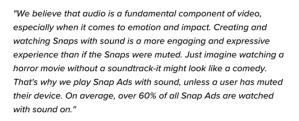 We all know how powerful the right music can be in drawing out emotion; Snap had figured out how do this in a way that enhanced rather than disturbed a user’s experience. As a result, Facebook announced the reversal of their audio-off default policy in 2017. Sound on would be its default unless a user muted their device.
The landscape changed, music made sense in some environments and not in others (so don’t forget about audio-off consumption people!). But music still wasn’t the most integral part of a platform until Music.ly (now TikTok) figured out a way to tap into the everyday creator, not just the talented creator that Vine had. It mashed up dubsmash and Vine, allowing users to lipsync. Yet another instance of a lower barrier to creativity.
Music ended up changing social media, but social media ended up changing music too. Ever hear of Lizzo or Lil Nas X? Their careers skyrocketed when users were able to create their own lipsynced versions of their top hits. Meme/music crossover culture is just the beginning and we’ll likely see this trend increase in 2020 and beyond as platforms, brands, and musicians continue to make users the stars.
10. Challenge Mentality
While we’re talking about TikTok, we might as well tip our hats to one of my favorite changes to social media in the past 10 years: challenge culture. Now I’m sure there were many challenges forced upon friends on social media before, but the ALS Ice Bucket Challenge in 2014 created magic. It fused the generous nature of younger generations with the ability to show off and go viral (Call Me Maybe anyone?), creating the most powerful examples of how social media can give back. But it also showed just how far we’d go to be a part of something. A movement doesn’t always have to be about raising money or making huge policy changes, it can also be just something fun that everyone does together. The mixture of memes, the popularity of the Ice Bucket Challenge and the growth of sound on social environments paved the way for TikTok. And in return, TikTok paved the way for challenges to become a pillar of what we consume and create on social media.
The past decade has been quite the social media revolution. So much so that it’s hard to include all of the big changes that have happened in a list of 10. Things like Augmented Reality, gaming, and social commerce have all become major forces in the social media landscape. While they may be a little too nascent for a 2010-decade post, we’re likely to see these and many more have a substantial impact on social media in 2020 and beyond.
























 Social Allie